
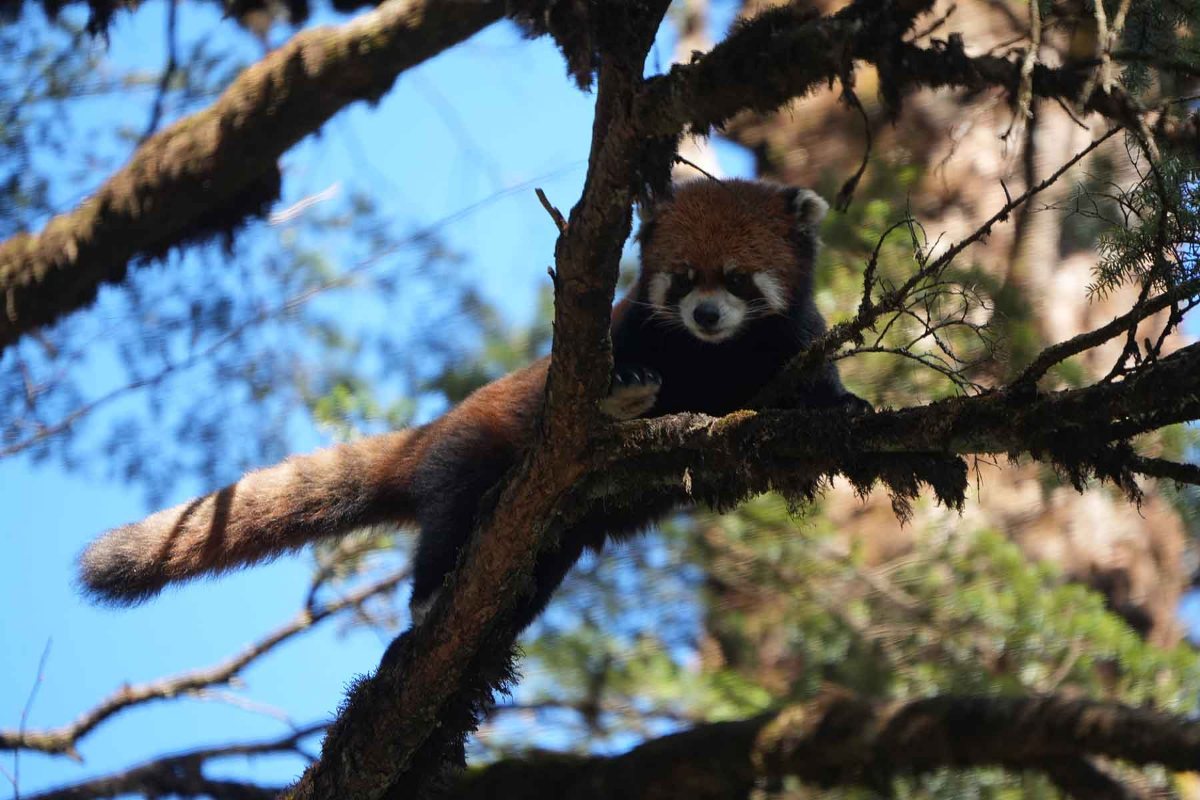
The red panda has a reputation as the hardest easy animal in Asia — present across a huge range, seen almost nowhere. That reputation is accurate for nearly all of it, and wrong for two specific forests in the Qionglai range west of Chengdu: Labahe and Wawushan. The published sighting rates for those two sites run above 80 per cent in season. The red panda tour, the mammal tour and the nature reserve tour are all built directly on that number.
What an 80 per cent sighting rate means.
It does not mean you have an 80 per cent chance in any given hour, and it is not a survey. It is a field estimate — the share of visiting groups that find the animal across a season, the number the parks themselves publish and our routes plan around. The honest reading: most weeks in season, most visitors see one. Some weeks, nobody does. The odds section on each route page carries exactly this framing, because a promise is the one thing wildlife cannot sign.
What the number does mean is that this is not a lottery. In most of the red panda’s range, seeing one is a lottery. Here it is a season.
Labahe and Wawushan.
Labahe is the working ground. The reserve runs a cable car up to Jiaoshan at above 3,000 metres and a boardwalk system through old-growth forest, and the red panda tour sleeps both nights at the park hotel inside the reserve — inside, because the animals move at first light and the gate does not. Tibetan macaques and sambar share the High line in the same forest; leopard cat, Sichuan takin and Lady Amherst’s pheasant are the realistic Medium company.
Wawushan is the flat-topped mountain an hour south — a plateau of moss forest that carries its own red panda population and works well as the second day of a longer trip. The nature reserve tour walks it as Day 03; the red panda tour adds it as an extension on Day 04.
The season, and why it is what it is.
The window the routes plan around opens in late August. The red panda tour’s best window runs late August to November; across the two parks the published rates stay above 80 per cent from late August through the autumn, and at Wawushan the season runs on towards spring. Outside the window the animals are still there — but a sighting rate is a season statement, not a year-round one, and the routes say so rather than averaging it away.
How a day actually works.
There is no fixed distance. A day at Labahe is the guide reading the forest — fresh feeding signs, a bamboo edge, a quiet stretch of boardwalk — and then waiting. “Search and wait” is the honest description of the full day, and the walking is short: into the forest to the animals, not along a track to a viewpoint. Travellers who need kilometres per day should look at the trekking routes; this trip measures its days in hours of stillness.
Building a trip around it.
Three days is enough for the dedicated red panda trip. Two directions extend it. East, the nine-day nature reserve tour adds Wawushan, Bifengxia, Wolong and the option of Baihe and Tangjiahe — the one trip where the giant panda is a certainty, at the Bifengxia base, while the wild panda stays a Rare line honest enough to say tracks, not animals. North, the eight-day mammal tour pairs Labahe with Tangjiahe’s takin and Baihe’s monkey troops.
And because an 80 per cent animal attracts a crowd, the way you behave at the sighting matters as much as finding it. Our watching-without-disturbing rules are the same for a fox on the plateau and a panda in a tree.
Sighting-rate framing and species lists checked 7 November 2026 against the route pages. They are field estimates, not survey results or promises for any single week.
Go and look?
The red panda tour, 3 days
The nature reserve hiking tour