
No page on this site hides the driving. The day cards carry it in the same type as the walking: “Drive, 3–4 hours”, “Drive, 6–7 hours”, “Bus, about 4 hours”. That honesty has a purpose. The road days are real, they are part of the price, and they are also part of the product — the hour when the trip crosses from the basin to the plateau and the window stops looking like Sichuan.
The arithmetic of hours.
The standard set: Chengdu to Kangding, three to four hours up the new highway. Chengdu to Rilong, four hours, under the Balang pass. Chengdu to Xinduqiao, the long one, six to seven hours — the drive the group trek splits with a pass walk on day one. The 24-day journey strings a dozen of these together, and its day cards treat a four-hour drive as a gentle morning. None of these numbers is padded and none is hidden: the grading page counts driving days as days, because they are.
The tunnels and the passes.
The engineering is part of the scenery. The Balang tunnel takes the northern routes under the pass “near 3,800 metres” — a sentence that used to be a two-hour climb of switchbacks and is now a light switch between one valley and another. The Ya’an–Kangding expressway burrows under the whole first wall of the plateau. What the tunnels saved in hours they also changed in kind: the road day is no longer an ordeal to survive but a crossing to watch, and the old pass roads that remain — Zheduo above Kangding, Yajiageng at 3,900 — are driven slowly, on purpose, because they are the views.
What you see from the window.
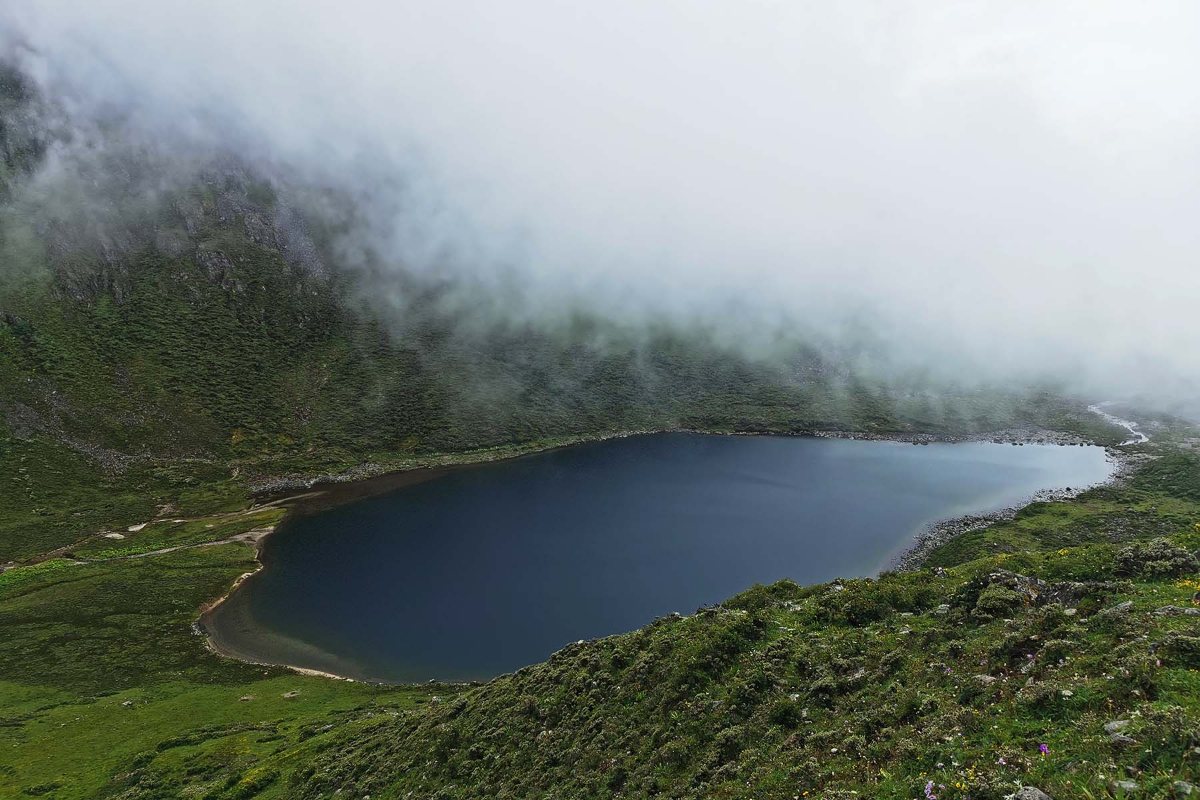
The drives are not dead time between landscapes; they are the sequence. Out of Chengdu the farmland thickens into gorges, the gorges into the tea country around Ya’an — the old road’s home ground — and then the first snow peaks appear in the windscreen somewhere past the tunnel. Above Zheduo the grassland opens with yaks in it; the road past Yajiageng runs beside the dark little lake in the pass’s shoulder, ten seconds of water that most passengers sleep through and nobody who is awake forgets.
Why the hours are also altitude.
The road days carry a second job that the timetable never prints: they are the climb. Every hour of driving east-to-west is a rung of the sleeping ladder — Chengdu at 500 metres, Kangding at 2,600, Xinduqiao at 3,400 — and the routes that acclimatise best are the ones whose long drives land at high, quiet towns with an easy afternoon attached. The altitude guide makes the same point from the other direction: the drive is not delaying the trip; up here, the drive is the first stage of it.
The honest way to take a road day.
Three habits, learned from guides. Sit on the mountain side of the vehicle where there is one — the driver will tell you which. Get out at every proper stop, even the unremarkable ones: the stops are chosen for what they show. And resist scheduling anything sharp for the evening of a seven-hour day; the routes that end their drives at Xinduqiao build the early dinner in for exactly that reason. The transport guide covers the trains and drivers between the cities; out here, the road day is the itinerary, and it has been all along.
Drive times, tunnel and pass details checked 7 November 2026 against the route pages.
Take the road?
The Western Sichuan tour, 9 days
Getting between routes: the transport guide