
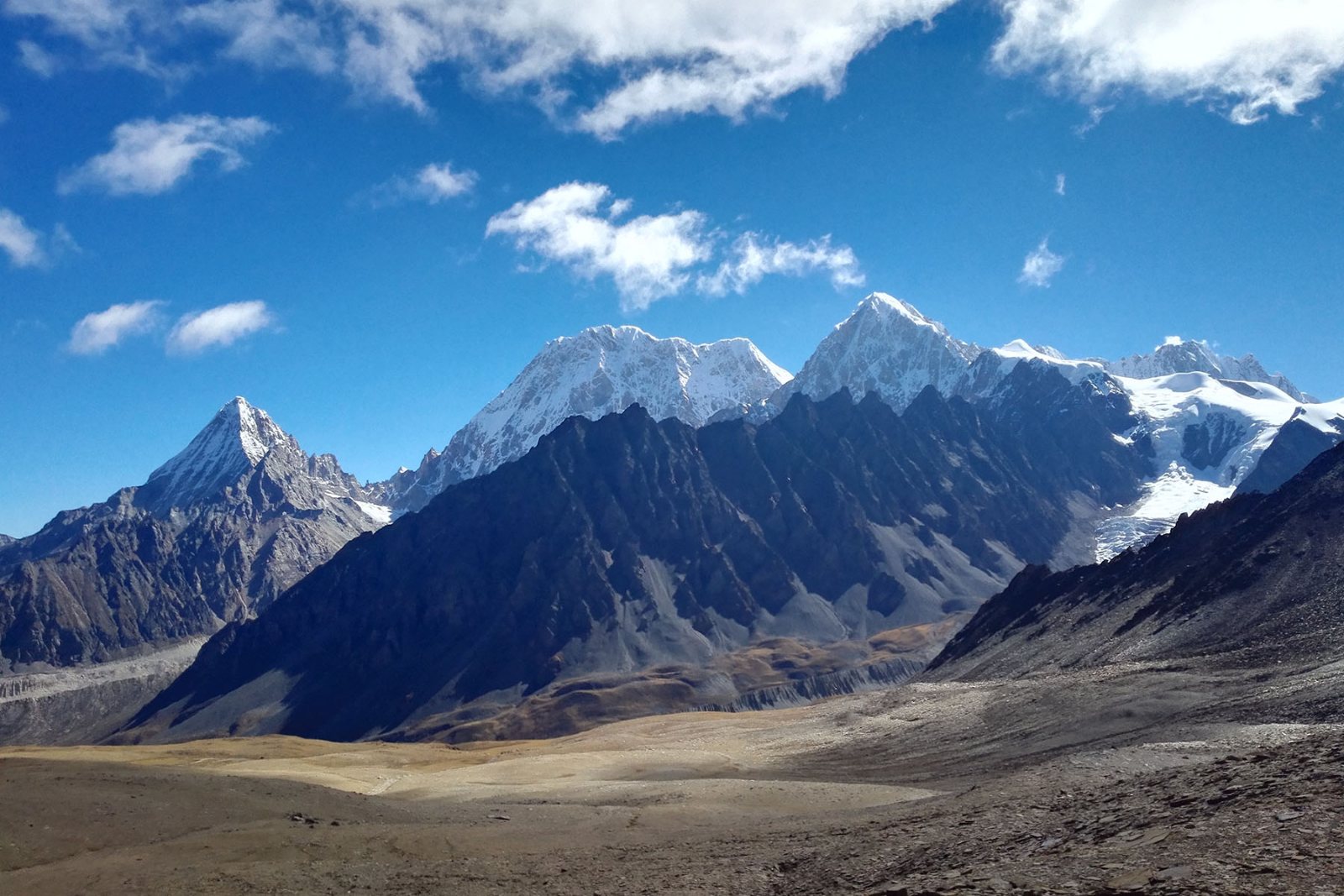
Minya Konka — 7,556 metres, the highest peak east of the Himalaya — sits a day’s drive west of Chengdu, and the country around it holds more walkable valleys than any other single mountain in China. We run five routes into that country. They share the same valleys, the same monastery, the same mirror lake and, on three of them, the same 4,950-metre pass. What separates them is not scenery. It is format: fixed dates or your dates, canvas or a bed, a day pack or eighty litres of everything you need for a week.
One massif, five formats.
The routes radiate from the same ground: the Riuqi valley on the mountain’s north-west, the Moxi valley below the glacier, the Gongga Gompa valley on the east, and the grassland country around Tagong and Yala to the north. The Riuqi Pass appears on three of the five routes because it is the single best day’s walking in the range — a 4,850- to 4,950-metre saddle with the whole west face across the valley. Whether you reach it with porters, a cook crew, or a stove on your own back is the real decision.
The five, compared.
| Route | Days | Nights camping | Highest point | You carry | How it runs |
|---|---|---|---|---|---|
| Group trek | 9 | 5 of 8 | 4,850 m, Riuqi Pass | Day pack | Join-in, fixed dates |
| In-depth trek | 9 | 3 of 8 | 4,950 m, Riuqi Pass | Day pack | Private, May–Oct |
| Panorama hike | 5 | 0 of 4 | 4,500 m walking | Day pack | Private, all year |
| Self-supported | 7 | 3 of 6 | 4,950 m, Riuqi Pass | Everything, 80 L | Private, May–Oct |
| Mt. Yala trek | 5 | 3 of 4 | 4,800 m, west-face pass | Day pack or self | Private, May–Nov |
Read the last column first. Two of the five run on set dates; three run whenever you ask. That distinction decides more than any line in the scenery column.
The group trek: the mountain on a schedule.
Nine days, seven departures from May to November, one price. The join-in trek follows the classic line — in via the Riuqi valley, over the 4,850-metre pass, alpenglow on the second pass above Yulongxi, the mirror lake at Langgatso, the monastery, base camp, and out over the Zimei viewpoint pass. Porters and packhorses move the camp, a cook crew feeds it, and you carry a day pack.
The terms are printed on the route page: CNY 8,200 per person, CNY 7,600 for a seat confirmed sixty days ahead, and a surcharge in the July and August departures (CNY 8,600, early booking CNY 8,000). Groups run two to eight, international trekkers only. One clause is worth reading twice: a departure that falls short of two trekkers a month out is cancelled, or runs at a supplement of up to 100 per cent. The private version of the same line starts from USD 2,110 per person in a group of four.
The in-depth trek: the circuit, slower.
Also nine days, private, with three camping nights instead of five — the rest in a hotel, the monastery and village lodges. It walks the same country in a different order, crosses the Riuqi Pass a hundred metres higher than the group route, and carries a deliberate buffer day at Reddomain camp, which is the single most useful feature a high trek can have: a day that exists to be rained on, snowed on, or simply spent watching the glacier. Some seasons the circuit walks better in reverse; that call is made by the season, not the brochure.
The panorama week: the whole range, all day, and a bed at night.
Five days, four hotel nights, no camping at all — sleeping between 3,400 and 3,700 metres while the walking reaches 4,500. The ridge days are real mountain walking, not a drive-between-viewpoints trip: a full day on the Minya Konka west trail with the entire range in view, a grassland ridge above Tagong, and the lakes under Mt. Yala. Because it never leaves the hotels, it runs all year, with the routes flexing to the season. It is the right answer for walkers who want the big views and the big walking days without a single night in a tent.
The self-supported trek: everything on your back.
Seven days, your tent, your cooking, your food and stove fuel — eighty litres of pack minimum. It reaches the same 4,950-metre Riuqi Pass as the private circuit, gets in and out by public bus, and is the only one of the five with an honest entry requirement rather than a soft one: prior high-altitude camping experience, or the honest answer is no. The deal it offers in exchange is the quiet one — walk alone and quietly and you see more.
Mt. Yala: the holy mountain next door.
Five days and one massif north of the Konka country. A holy lake, a hot-spring camp, and a 4,800-metre pass directly under Yala’s west face. Three of four nights are tents; a guided-backpack version exists for trekkers who want to carry their own gear but not the kitchen. In snow season the pass goes out of play and a safe variant runs instead — the season on the route page is May to November for the pass itself.
How to choose.
If you want the classic line and a set date: the group trek. If you want the same country on your dates with a buffer day: the in-depth circuit. If you want the views and the ridge days without camping: the panorama week. If you want to test yourself: self-supported, and be honest about your camping history when you enquire. If you want a shorter, wilder crossing with a hot bath in the middle: Yala.
And if four days is what you have, the Riwuqi trek walks the group route’s first two valleys as a standalone — same camp twice, the glacier lake, and back in time for a Sunday flight.
Days, altitudes, camping-night counts and prices checked 7 November 2026 against the route pages. Prices are per person as printed there; currency and booking windows differ by route.
Walk one of these?
The Minya Konka group trek
The Gongga in-depth trek
The Minya Konka panorama hike