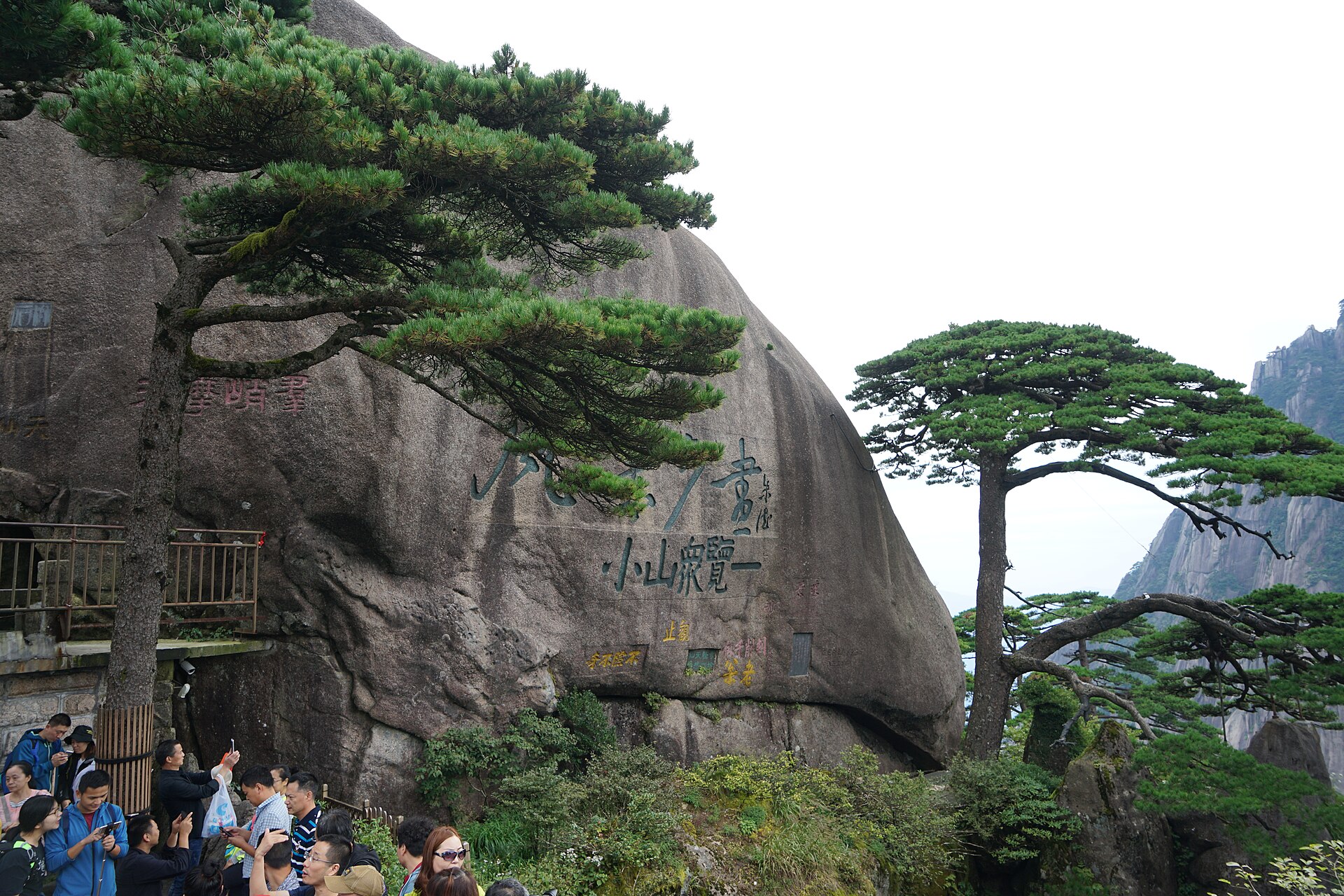
A walking trip with a sense of place.
Huangshan rewards walkers who understand the role of stairs. Cable cars shorten the approach, but the upper mountain remains a network of ascents, descents and viewpoints. The villages below it are a different walking product entirely — one vertical, one level — and the second is not a footnote to the first.
The options below are planning suggestions, not fixed departures. Walking time, entry arrangements and the final route are confirmed for your dates and group. A half-day or full-day label describes the proposed outing, not a guaranteed trail duration.
Choose the walk that fits.
Cable-car-assisted mountain day
Full day · repeated stepsSelect a compact upper-mountain circuit with a realistic return to the descent station. This suits travellers who want the mountain landscape without an overnight, but requires allowing for transfers and queues as well as walking.
One night on the mountain
Two days · moderate to demandingWalk to your confirmed mountain hotel with a light overnight bag. Use the second day for another open section before descending. Accommodation location should determine the route; sunrise is an opportunity, not a guaranteed event.
Two days, one of each
Two days · one vertical, one levelGive the mountain its day and the villages theirs, in that order, rather than treating the descent as the end of the walking. The mountain needs an early start and a full day; the village day needs the opposite — a slow middle and an evening after the coaches have gone.
The villages are not an afternoon.
Most itineraries handle Huizhou as a reward after the mountain: an afternoon of lanes on the way back to the station, timed around lunch. That is a category error. The villages are a separate walking product with their own distances, their own tickets and their own best hours, and trying to see them between a descent and a train is how people end up remembering Huizhou as a car park.
The distinction is physical. Huangshan is vertical: 1,500 m of ascent distributed across thousands of steps, weather that changes at the ridge, and a summit you have to earn by walking. The villages are level: two to eight kilometres a day through lanes and field paths, with the difficulty coming from density rather than gradient. Nothing in a village requires fitness. Everything in a village requires time.
What the mountain asks
An early start, a real day, knees that tolerate descent, tolerance for cloud and queues at the cable car, and a willingness to be on stone steps for six hours. One night on the mountain improves it; a day trip flattens it into a checklist.
What the villages ask
Timing rather than effort. Hongcun and Xidi fill with coaches between mid-morning and mid-afternoon, and the lanes are narrow enough that a group of forty closes them. Before nine and after four the same villages are quiet, working places.
What it costs
The mountain is one ticket and two cable cars. The villages are priced individually: Hongcun and Xidi around ¥104 each, Chengkan around ¥107, Tangmo ¥80, Nanping ¥38, Lucun ¥45. A village day is not cheaper than a mountain day — it is differently expensive.
Where to sleep
Staying inside a village changes the day more than any other decision, because it gives you the lanes at dawn and after dark. Rooms in converted merchant houses are small and often thin-walled. That is the trade, and it is worth making once.
The region also holds a network of stone roads that predates the villages as a visitor attraction and has nothing to do with either the mountain or the lanes — 77 routes catalogued in Huangshan municipality alone, several of them walkable in a day. Our Huizhou trails overview maps five of them, and Huizhou village walks covers the three village loops in detail.
Know before you go.
Choose your overnight carefully
A hotel in Huangshan City is not on the mountain. Tangkou, the rail gateway and mountain hotels play different roles. Confirm where large luggage stays, how far you must walk to the room and whether your chosen route fits the arrival and departure arrangements.
Open routes change
Individual peaks and canyon paths can close for maintenance, conservation or weather. A published route diagram is a planning aid, not a guarantee. Choose the day’s circuit against current opening information and the descent deadline.
Seasons and mountain weather
Cloud is part of Huangshan’s character. Wet steps, wind and winter ice can make a short circuit slow; summer storms can interrupt lifts. Keep warm layers and waterproof protection available even if the lower town is warm.
A practical walking style
Use a light bag and shoes with reliable grip. Build pauses into stair-heavy sections and avoid forcing a summit checklist on tired knees. If anyone has mobility limitations, review the exact route because mechanical access rarely means a step-free visit.
A possible journey.
This is an itinerary outline to adapt around your arrival, preferred pace and available walking days. Accommodation, transfers, entry and guiding are confirmed in a written trip proposal.
- Arrive and stay near the appropriate mountain access point; leave large luggage at the agreed base.
- Ascend, follow a measured upper-mountain route and stay overnight if selected.
- Descend with time for transfers, then shift to a Huizhou village stay and a gentler walking day.
Prepare for the actual route.
Bring broken-in walking shoes with grip, a small daypack, water, a weather-appropriate layer, rain protection and sun protection. Carry any personal medication and a charged phone; download your hotel address and meeting point for offline use. Let us know if long steps, uneven ground or a sustained descent are a concern.
For a useful quote, tell us your travel dates, group size, recent walking experience, preferred accommodation and whether you want a guide, transfers and luggage support. Ask the proposal to distinguish entrance fees, cableways, meals, guide service and optional activities. No price or inclusion is implied by this guide.
Read our China walking and trekking packing guide for the broader journey, then adjust it to this route rather than packing for an expedition by default.
Your questions, answered.
Is an overnight worth it?
It provides more walking time and a chance to see changing light, but adds cost and luggage logistics. A carefully chosen day circuit can still be rewarding.
Will we see the sea of clouds?
It depends on the weather. Plan for the mountain itself rather than a guaranteed photographic condition.
Does a cable car make the trip easy?
It saves approach effort. Many upper routes still involve long sequences of steps.
References & photography.
Reference material supports destination context; check local opening arrangements before travel. The route choices and itinerary above are our planning suggestions.